

What Percent Of Trucks Are Certified Clean Idle
Visit NAP.edu/10766 to get more information about this book, to purchase it in print, or to download it every bit a free PDF.
« Previous: 5 Vehicle Power Demands
Suggested Citation:"six Engine Idle Reduction." National Academies of Sciences, Engineering, and Medicine. 2022. Review of the 21st Century Truck Partnership: Third Report. Washington, DC: The National Academies Printing. doi: x.17226/21784.
×
half-dozen
Engine Idle Reduction
INTRODUCTION
Engine idle reduction was discussed in the National Inquiry Quango (NRC) Phase 2 report (NRC, 2022); this report provides a brief update. Engine idling, in sleeper tractors lone, uses 2 billion gallons of diesel fuel fuel according to a recent study (NACFE, 2022). The engine is idled (1) while waiting in queues at weigh stations, toll booths, ports and depots, (2) to maintain temperature in the cab for the comfort of the driver both mean solar day and night, (three) to power electrical appliances such as refrigerators and microwave ovens, (4) to maintain the charge level of batteries, and (5) to maintain the temperature of the engine oil and fuel during common cold weather. Unnecessary idling leads to increased fuel consumption also as emissions of carbon dioxide (CO2), criteria pollutants, and dissonance. Reducing idling and associated fuel consumption can be avoided with idle reduction technologies, attention to policies affecting freight efficiency, and changes in driver behavior, e.g., turning off the engine when not needed. Over a decade ago, information technology was common for trucking companies to report idle time in backlog of 50 pct. Fleets with practiced operations would often study 35 percent idle time, and a benchmark number was below 20 percent. Today, it is more common for these same fleets to report worst case numbers around 35 percent, and averages about 20 per centum, with benchmark numbers suggesting as low as five percent (NACFE, 2022, 2022). Unfortunately, there is no specific and agreed-on method for determining idle time. The electronic control modules (ECMs) on the engines are the source of this information for fleets. How an individual engine manufacturer decides to calculate idle fourth dimension varies. Some may exclude time waiting in traffic, while others practice not. Some may exclude initial idle at start before the vehicle moves. Time limits are often used in the ECMs to differentiate between idle and nonidle operation of the engine.
California remains a leader in regulations related to idling. Equally noted by the California Air Resource Board (CARB), "pursuant to state regulation, operators of diesel-fueled trucks with a gross vehicle weight rating greater than 10,000 lb are non to idle for more than 5 minutes when stopped within California's borders. Every bit of January 1, 2008, this restriction also applies to sleeper berth trucks. Consequently, many operators are now required to use some grade of idle reduction technology to provide cab comfort services during periods of sleep and residue" (CARB, 2022). Beginning in 2008, idling for more than 5 minutes on most commercial vehicles was allowed, only required a Certified Clean Idle sticker. According to CARB, a Certified Clean Idle label is for vehicles that use an engine that has been certified to an optional NO x idling emission standard of 30 g/hr.1 Additional information virtually California'southward commercial vehicle idling regulations and idle reduction technologies are given by the California Environmental Protection Agency's CARB (2013, 2022).
The clean idle engine reduces nitrogen oxide emissions compared to older engines, but however burns fuel. While these new, clean idle engines burn less fuel while idling than older engines, estimates for the corporeality of fuel burned while idling vary from virtually 0.13 gallons per 60 minutes for a diesel-powered auxiliary unit, to every bit much as 1 gallon per hour for the principal engine at certain speeds (Curran et al., 2022; Detroit Diesel Corporation, n.d.). Engine manufacturers do not regularly include a specification for idling fuel consumption in their product literature.
Anti-idling regulations around the country have been driven by the need to reduce fuel use, emissions, and dissonance. A patchwork of regulations at the state and municipality level has been created. The National Idling Reduction Network News website run by the U.South. Department of Energy (DOE) is updated monthly with data on idling; Figure 6-1 is taken from the Baronial 2022 issue. It shows the changes in coverage of idling regulations throughout the l states. Annotation that there are more than areas with "jurisdictional" regulations than with statewide regulations.
________________
1 Encounter http://www.arb.ca.gov/enf/advs/adv376.pdf.
Suggested Commendation:"6 Engine Idle Reduction." National Academies of Sciences, Engineering science, and Medicine. 2022. Review of the 21st Century Truck Partnership: Third Report. Washington, DC: The National Academies Press. doi: ten.17226/21784.
×
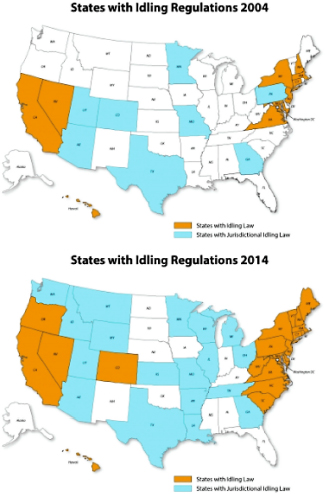
Figure 6-ane Extent of truck idling regulations in the United States, 2004 and 2022. In 2022 there were idling regulations in 20 states and the District of Columbia, compared to x states and the Commune in 2004. In that location are now jurisdictional laws in 18 states compared to 8 in 2004. SOURCE: DOE (2014).
The Due north American Council on Freight Efficiency (NACFE) in conjunction with the Carbon War Room published a report on idle reduction technologies in 2022 (NACFE, 2022); this document provides an update on currently available products and technologies.
21CTP IDLE REDUCTION GOALS
The electric current stated goals of the Partnership related to idle reduction were provided in a document in November 2022 (DOE, 2022). Compared to some of the other goals of the Partnership, these goals are full general in nature rather than specific and time limited. The goals and some activities and accomplishments take been identified and are discussed below:
- Promote the incorporation of idle reduction (IR) equipment on new trucks as fuel-saving devices, just every bit they are so identified by the DOE SuperTruck Initiative. The four SuperTruck teams have all decided to utilise battery-powered auxiliary power units (APUs) for the free energy needs during the rest portions of the 24-60 minutes bike of the program. The Partnership suggests it would exist worthwhile to carry a comparison of performance and lifetime costs of battery-powered APUs to those of diesel fuel-fueled APUs and to publish the results in the IdleBoxii web tool run past Argonne National Laboratory.
- Institute a nationwide multimode IR education plan. Argonne National Laboratory created IdleBox, an electronic resource of idling reduction materials. It includes a calculator that fleets tin can utilise to assess idle reduction needs. IdleBase is a component of IdleBox that provides a compendium of every state'south idling reduction laws. ANL too publishes the online monthly National Idling Reduction Network News for DOE, which contains important information on funding sources, changes in regulations, and updates to weight exemptions for APUs.
- Work with OEM truck manufacturers to obtain data on the number of new trucks being ordered with IR options. Considering many vehicle original equipment manfacturers (OEMs) consider information on sales information to be confidential and proprietary, the Partnership was unable to get complete data for this goal. Figure 6-ii shows the information reported by some manufacturers. The Machine Engine Start/Stop item is a feature available that automatically starts and runs the engine for a express amount of time if the cab temperature drops, the engine oil temperature drops, or the battery accuse, as measured by voltage, gets low.
- Conduct a armada survey to gather data on the amount of in-employ idling hours that are accumulated by each blazon of heavy-duty vehicle. This goal has not been met for a combination of reasons such every bit lack of funding and need for Role of Management and Budget (OMB) approval for surveys involving more than than ten people. Alternatives based on data from the National Renewable Energy Laboratory's (NREL'southward) Armada Deoxyribonucleic acid project and a revival of the Vehicle Inventory and Use Survey (VIUS) have been discussed.
- Analyze information from the EPA SmartWay Transport Partnership to measure fuel savings and emissions reductions associated with the various types of IR equipment available. No information was made available with which to evaluate this goal.
- Develop improved IR systems to minimize fuel required, cost, and weight to run across hotel functions in sleeper cabs. The SuperTruck program; the CoolCab Thermal Load project; the CoolCalc heating, ventilation, and air conditioning (HVAC) model; and Pace
________________
2 Meet IdleBox Toolkit for Idle-Reduction Projects at http://www1.eere.free energy.gov/cleancities/toolbox/idlebox.html. Accessed February eighteen, 2022.
three 1000. Keller, ANL. "Update on Idling Reduction Activities," presentation to the committee, September 4, 2022, and D. Anderson, "Vehicle Systems Simulation and Testing," presentation to the commission on September 3, 2022.
Suggested Citation:"6 Engine Idle Reduction." National Academies of Sciences, Applied science, and Medicine. 2022. Review of the 21st Century Truck Partnership: Third Report. Washington, DC: The National Academies Press. doi: 10.17226/21784.
×
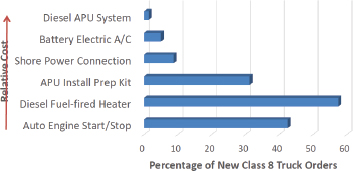
FIGURE six-ii Typical society rate for idle reduction devices in new trucks. SOURCE: DOE (2014).
- are activities that support this goal.3 Each of these activities is briefly discussed beneath.
PROJECTS AND ACTIVITIES
The 21st Century Truck Partnership (21CTP) has difficulty identifying specific projects and funding devoted to all idle reduction activities and projects. Idle reduction activities are found in the SuperTruck program, the Clean Cities program, and elsewhere. In a presentation to the committee on September 3, 2022, "Update on Idling Reduction Activities," Thousand. Keller identified four specific projects (CoolCab, CoolCalc, the ShorePower Truck Electrification Projection [Step], and SuperTruck) as being R&D projects in this surface area. Funding data was reported for the first two projects, CoolCab and CoolCalc, as $575,000 in 2022, $i,200,000 in 2022, and $500,000 in 2022. The Jan 2022 issue of the National Idling Reduction Network News reports up to $211 million having been spent on idle reduction activities in the "final decade" by the Partnership organizations, the private sector, and united states of america.
All four teams for the SuperTruck program (Daimler, Volvo, Cummins-Peterbilt, and Navistar) have called battery-powered APUs (see Chapter eight). For the Cummins-Peterbilt team, the NRC Phase 2 report recommended abandoning the solid oxide fuel cell (SOFC) approach for the APU (NRC, 2022). The team and the Partnership continued for a catamenia of time with the SOFC approach but somewhen stopped that effort because the SOFC approach was found to be heavier, more than plush, and to take longer to warm upward than specified in the goal. Currently it is using a battery-powered APU with a 13.ii kWh capacity lithium-ion pack and electrically controlled HVAC. The pack tin be recharged in vi hours of driving. Over the 24-hr duty cycle of the plan, a 7 percent savings in fuel has been reported compared to the baseline called for the SuperTruck program.4 The Daimler squad is using a hybrid drivetrain configuration that includes a lithium-ion bombardment pack and electrically controlled HVAC. To reduce the need to cool the cab, information technology is using solar reflective paint, similar to the CoolCab projection. They are reporting a 3 pct fuel savings compared to the baseline chosen for the SuperTruck programme.five Volvo Trucks is as well using a battery-powered APU and electrically controlled HVAC. It is in the process of installing solar panels to assist in charging.6 However, during a visit to Volvo, the committee learned that the solar panels would only be able to support the electrical load of a fan.
The CoolCab and CoolCalc projects at NREL are normally classified as thermal management projects by DOE. They have investigated advanced insulation technologies to reduce the load, the ability of unlike paints to better reflect sunlight, and techniques to cool the occupant rather than the whole cab. Reducing these thermal loads increases the potential for using battery-powered APUs rather than idling the engine. The energy remainder for recharging the batteries while the vehicle is operating has not been reported.
An analytical HVAC system model and test methods called CoolCalc will be useful to further these investigations. The projects were expected to have been completed in 2022.
STEP, too referred to as Interstate Grid Electrification project ARRA VTO 70, is a split up project supported past American Recovery and Reinvestment Deed (ARRA) funds. Fifty truck stops have been outfitted with electrical power outlets only, sufficient to support 1,252 vehicles. The build-out of the system took longer than anticipated attributable to varying municipal regulations at the different sites every bit well as prolonged negotiations with some truck finish owners. The Cascade Sierra Solutions projection was replaced past STEP in 2022. Data collection is under style and is reported by NREL. Utilization of the pedestals and electrical connections was reported equally less than xx percent in 2022 status reports. Pace provides just electrical power and does non provide for as many amenities for the commuter as might be desired. For instance, IdleAir is a supplier providing HVAC externally, cyberspace connectivity, satellite goggle box, and 120-Five electricity. Recently, Con-Way Truckload appear a dedicated IdleAir facility in its Laredo, Texas, facility (Owens and Bachman, 2022). A final written report is due in 2022.
RESPONSE TO RECOMMENDATIONS FROM THE NRC Phase two REPORT
NRC Stage 2 Recommendation 6-ane. DOE, EPA, and DOT should develop a consolidated listing of the funding provided for the idle reduction projects, review the effectiveness of these projects, and codify a coordinated and consequent plan to encourage the adoption of idle reduction technologies to meet the goal of reducing fuel use and emissions produced by idling engines by at to the lowest degree ii-thirds past 2022. The EPA and DOT
________________
4 Ibid.
5 Ibid.
6 Ibid.
Suggested Citation:"half dozen Engine Idle Reduction." National Academies of Sciences, Engineering, and Medicine. 2022. Review of the 21st Century Truck Partnership: Third Study. Washington, DC: The National Academies Press. doi: x.17226/21784.
×
should work to find incentives for states to promulgate uniform anti-idling regulations.
21CTP Response: Presently, the National Idling Reduction Network News publication reports the various sources for funding idling reduction programs culled from press releases. Nosotros concur that a consolidated listing of these projects would be useful. The recommendation calls for a more coordinated endeavour between the DOE, EPA, and DOT to maintain the momentum begun in the awarding of idling reduction (IR) technologies, and to ensure minimal overlap of these programs across agencies. Establishing a more than structured approach to the introduction of IR devices would exist conducive to introducing objective measures to monitor the effectiveness of these various programs. Further, nosotros agree that achieving nationwide uniformity of anti-idling regulations needs to be accomplished soon, and that the EPA and DOT could be instrumental in developing incentives to states to pass such rules.
Committee Comment on Response to half dozen-1
The Partnership response, while supportive of the Phase 2 Recommendation half-dozen-one, does not advise activity volition be taken in this area. The Partnership was asked for and did provide some input on the idle reduction study of NACFE. In consideration of their goals in this expanse, more work should accept been done autonomously from the SuperTruck program to accomplish idle reduction for current vehicles now in the field. Going frontwards, with the completion of the SuperTruck program, the Partnership will need to readdress its activities in this area.
***
NRC Phase 2 Recommendation vi-ii. The DOE should bear a study that includes wide ranges of truck models, ages, and fleets to determine payback periods for the range of commercially bachelor add-on idle reduction systems. The DOE should go along to encourage the deployment of addition idle reduction systems through communications to manufacturers and cease users.
21CTP Response: The 21CTP agrees with NAS that it would be valuable for DOE and EPA to fund a comprehensive study to verify the performance and payback claims of addition idle reduction systems across a diverseness of popular trucks and climate regions. Such a study would exist extremely valuable to the trucking community in helping to identify the well-nigh cost-effective improver systems to invest in for their particular applications. The DOE could share these written report results with quarterly updates as an annex to the National Idling Reduction Network News publication.
Commission Comment on Response to 6-2
While the Partnership agreed with Stage 2 Recommendation 6-2, in that location is no evidence that anything has been done that addresses this recommendation. The number of options bachelor for anti-idle accept increased, just their effectiveness is withal a question. The study from the Due north American Council for Freight Efficiency provided a payback calculator, but more work among the Partnership, DOE, EPA and NACFE is needed to validate or refine this model.
***
NRC Stage 2 Recommendation 6-3. The DOE should reassess the viability of the Solid Oxide Fuel Prison cell (SOFC) APU, specially for application to the SuperTruck programme.
21CTP Response: The information presented during the 21CTP NAS review was based upon one of our initial A-Level prototype units. Since then, we have fabricated significant progress and are now assembling our B-Level prototype units. These units should be capable of demonstrating the targeted goal of 35% efficiency and output of 3kW. On the SOFC stack, Delphi has completed more than 10,000 hours of durability testing. Additionally, nosotros have accumulated thousands of hours of on-truck, real-work application data. We are scheduled to evangelize a B-Level unit during Q1 '12 to a national fleet for employ on i of their regular in-service long haul trucks. Currently, our start-up fourth dimension is ~ii hours. The 5-60 minutes example reported on represented a given demonstration. Our goal is to be at operating temperature in nether one hr. Current costs reverberate laboratory built epitome units. Delphi is investing in production intent tooling to bulldoze down overall unit toll. Funding to date has allowed Delphi, equally well as other fuel cell developers, to motility their products from concept design to existent-world demonstrations. Congress has recently reinstated funding for SECA and other fuel cell programs. Delphi will use the re-funded SECA program to further ameliorate the ability output and durability of its SOFC stack.
Committee Comment on Response to 6-3
The Partnership rejected the Phase two Recommendation six-iii. Subsequently, the SOFC was eliminated from the plans of the SuperTruck teams (both Daimler Trucks Northward America and Cummins-Peterbilt explored this). At the International Motorcar Association (IAA) bear witness in September 2022, a diesel-fueled SOFC APU was on display; Eberspaecher is planning commercial introduction of SOFC APUs in Grade 8 trucks in 2022-2017 (Eberspaecher, 2022). Activities for fuel cells go along at AVL and Volvo (Rechberger et al., 2022). Based on developments in Europe, there is a need to reevaluate the future of fuel cells for idle reduction and other auxiliary loads on commercial vehicles.
***
NRC Stage two Recommendation 6-four. The 21CTP should review and potentially revise its idle reduction plans and goals in view of the fact that the proposed 2022 fuel efficiency standards provide an incentive for the adoption of idle reduction technologies as a means for achieving these standards for Class 8 long-booty trucks with sleeper cabs.
21CTP Response: The 21CTP agrees that the EPA's rulemaking to institute fuel efficiency standards for heavy-duty truck fleets provides an incentive to look beyond Class 8 long-booty trucks with sleeper cabs to other types of trucks for additional opportunities to employ idle reduction technologies. Nosotros feel that
Suggested Commendation:"half dozen Engine Idle Reduction." National Academies of Sciences, Engineering, and Medicine. 2022. Review of the 21st Century Truck Partnership: Tertiary Report. Washington, DC: The National Academies Press. doi: 10.17226/21784.
×
a substantial improvement to the idle reduction goal would include back up to establish a programme to address the fuel wasted in piece of work day idling of all types of vocational trucks.
Committee Comment on Response to 6-four
The Partnership response indicates understanding with the Phase 2 Recommendation 6-iv, but no activeness has been taken in this area. Equally the Partnership looks across the SuperTruck program, the value of get-go/cease, battery-operated or fuel-cell operated booms on electrical utility trucks, and options for heating and cooling without running the primary engine needs to be investigated.
***
NRC Phase two Recommendation 6-five. The 21CTP should revise its new idle reduction goals to include metrics, funding, and timing for the overall goal of reducing fuel utilize and emissions produced past idling engines. The associated "action items" should be supportive of these goals.
21CTP Response: The 21CTP agrees with the NAS recommendation that the inclusion of a progressive and measurable programme for idle reduction goals development is needed forth with the twelvemonth-to-year funding necessary to develop information to enable such an approach.
Committee Comment on Response to 6-five
The response to the Stage 2 Recommendation 6-5 indicates agreement in this area but based on the reference to needed funding it would seem to lack signs of commitment.
FINDINGS AND RECOMMENDATIONS
Finding 6-ane. Improvements have been made in reducing idle time for long haul trucks over the last 10 years. The growth of fleet management systems and efforts past the Partnership, DOE, EPA, and the California Air Resources Lath (CARB) have helped fleets sympathize the impact and the methods available to reduce idle time. No consistent way to measure and rail idle fourth dimension has been found, since algorithms are independently determined by the developers of the software for engine controls and fleet management systems.
Finding 6-2. The Partnership has focused much of its effort on the SuperTruck programme and made progress in highlighting the bear on of idling by including a 24-hr cycle in its fuel employ evaluation. The stated goals for data acquisition and data analysis have not been met.
Recommendation 6-1. The Partnership, in collaboration with EPA, the National Highway Traffic Condom Assistants (NHTSA), and CARB should review the North American Council for Freight Efficiency (NACFE) payback calculator and establish a consistent way to measure out and track idle fourth dimension for both over-the-road and vocational vehicles. Equally a follow-on, the Partnership should run a program for field information conquering and analysis, leveraging the resources of NACFE and its fleets.
Recommendation vi-ii. Every bit the Partnership looks across the SuperTruck program, the value of get-go/stop systems, battery-operated or fuel-cell operated auxiliary loads, and options for heating and cooling without running the primary engine should be investigated.
Recommendation 6-iii. The Partnership should constitute goals, specific plans, and funding to reduce the nation's consumption of fuel for idle by over 50 percentage past 2025. The baseline should be from the estimate the Partnership generates for full 2022 idle fuel usage based on information to exist acquired from the field using DOE'due south Fleet DNA project and working with fleets, industry associations, and vehicle OEMs.
REFERENCES
CARB (California Environmental Protection Agency Air Resources Lath). 2004. Airborne Toxic Control Measure to Limit Diesel-Fueled Commercial Motor Vehicle Idling. http://world wide web.arb.ca.gov/msprog/truckidling/2485.pdf.
CARB. 2022. Facts about California's Commercial Vehicle Idling Regulations. http://www.arb.ca.gov/msprog/truck-idling/factsheet.pdf.
CARB. 2022. Idle Reduction Technologies for Sleeper Berth Trucks. http://www.arb.ca.gov/msprog/cabcomfort/cabcomfort.htm.
Curran, S., K. Settles, and K. Keel-Blackmon. 2022. ORNL Operations Best Practices Guide: Idle Reduction. Oak Ridge National Laboratory Sustainable Campus Initiative. https://sustainability-ornl.org/documents/ORNL%20Idle%20Reduction%20Guide.pdf.
Detroit Diesel fuel Corporation. n.d. Fuel Economy: Creating Optimal Performance. http://world wide web.demanddetroit.com/pdf/functioning/5927-3_DD_FuelEcon_FINAL.pdf.
DOE (U.Southward. Department of Energy). n.d. Vehicle Technologies Office: National Idling Reduction Network News. http://energy.gov/eere/vehicles/vehicle-technologies-office-national-idling-reduction-network-news.
DOE. 2022. 21CTP Idle Reduction Goal Status. Submitted to the NRC Commission for Review of the 21st Century Truck Partnership, Stage 3, November 17.
Eberspaecher. 2022. Eberspaecher at the IAA Commercial Vehicles 014: Diesel fuel-prison cell APU revolutionized energy management in the truck. Press release, July 17. https://www.eberspaecher.com/index.php?eID=download&file=fileadmin/data/corporatesite/presse/pressemitteilungen/2014_presse/pressemitteilungen/PR_IAA_CV_2014_preliminary_report.pdf.
NACFE (Northward American Council for Freight Efficiency). 2022. Anti Idling Engineering Overview. http://nacfe.org/wp-content/uploads/2013/08/Trucking-Efficiency-Anti-Idling-Tech-Overview-072413.pdf.
NACFE. 2022. Conviction Report on Idle-Reduction Solutions. http://www.carbonwarroom.com/sites/default/files/reports/Idle-Reduction_Confidence_Report.pdf.
National Enquiry Council (NRC). 2022. Review of the 21st Century Truck Partnership, Second Written report. Washington, D.C.: The National Academies Printing.
Owens, K., and K. Bachman. 2022. Con-manner Truckload Opens Idle Air Facility at Laredo, Texas, Terminal. Con-way Press Release. http://www.con-style.com/en/about_con_way/newsroom/press_releases/Dec_2014/2014_dec_09.
Rechberger, J., A. Kaupert, C.G. Greisen, J. Hagerskans, and L. Blum. 2022. Fuel-cell APUs bear witness promise for heavy-duty truck anti-idling. SAE Off-Highway Engineering Online. http://articles.sae.org/12659/.
Next: 7 Safety »

Source: https://www.nap.edu/read/21784/chapter/8
Posted by: hancehoweenton.blogspot.com
0 Response to "What Percent Of Trucks Are Certified Clean Idle"
Post a Comment